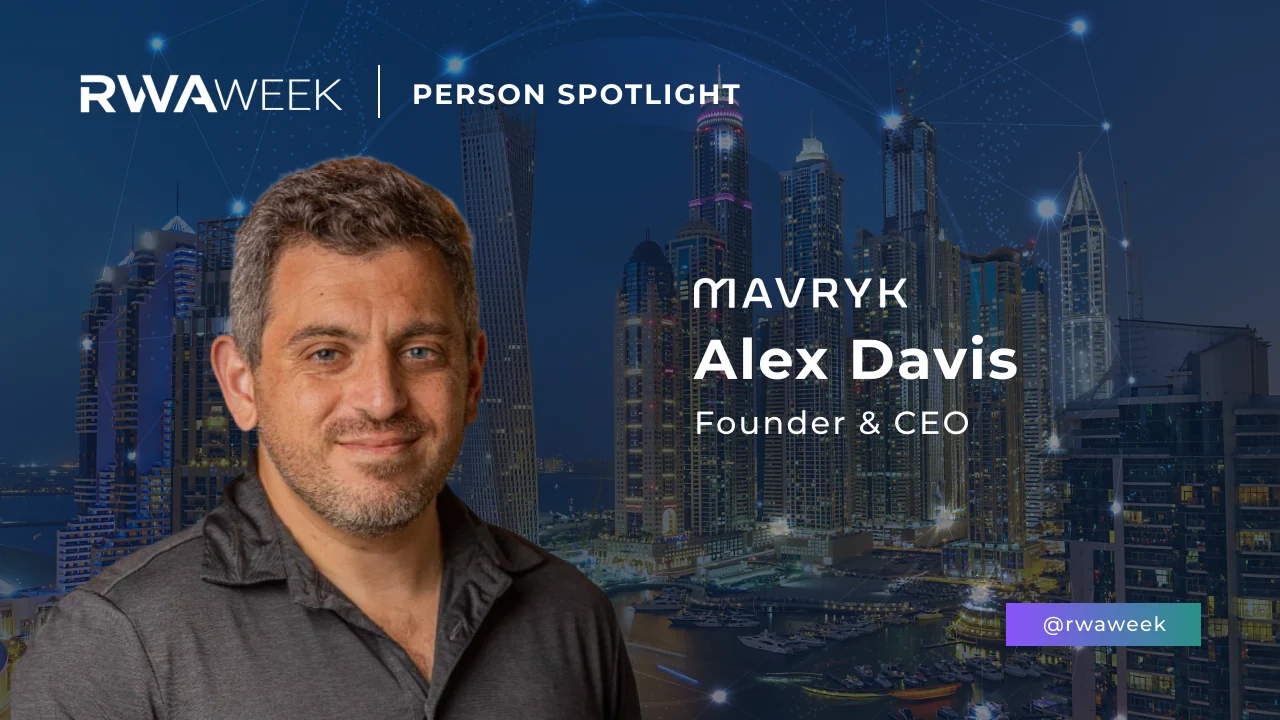
Person Spotlight: Alex Davis, Founder & CEO of Mavryk Dynamics
Alex Davis explains why compliance-native token standards, integrated market infrastructure, and collateralised liquidity are central to institutional RWA adoption.
Alex Davis
Founder & CEO, Mavryk Dynamics
Navigating the intersection of sovereign-level security, complex financial regulations, and decentralised infrastructure requires a founder with a multidimensional perspective. Alex Davis brings that background to the real-world asset (RWA) space.
Spanning government strategy, defence, geopolitics, and fintech, Alex previously served as Chief Innovation Officer for Tezos MENA. There he observed the friction between traditional institutions seeking asset digitisation and public blockchains ill-equipped to handle strict legal and operational boundaries.
To address that gap, Alex launched Maven Finance, a DeFi lending protocol on Tezos designed to accept security token offerings as collateral, before expanding the vision into Mavryk Dynamics. As Founder & CEO, Alex now leads Mavryk Dynamics as a full-stack, purpose-built Layer-1 blockchain ecosystem that unifies issuance standards, permissioned DEXs, OTC venues, and decentralised credit protocols.
About Mavryk Dynamics
Mavryk Dynamics is a vertically integrated Layer-1 blockchain ecosystem purpose-built for the tokenization, trading, and collateralised lending of real-world assets. By unifying compliance-centric token standards, multi-engine permissioned exchanges, and non-custodial credit protocols under a single architecture, Mavryk provides institutional asset managers, sovereign partners, and global enterprises with an end-to-end framework to bring real-world value on-chain.
Background & Experience
How did navigating risk-sensitive, highly regulated environments shape your decision to build a blockchain framework centred around strict regulatory compliance?
My background sits at the intersection of things that do not usually show up on the same résumé: libertarian ideals, geopolitics and defence, fintech, and finance. What that world teaches you above everything else is the asymmetry of failure.
In consumer technology, if you ship something broken, you patch it on Tuesday. In risk-sensitive environments, you assume an adversary, map the worst-case chain of events, and design for the day it goes wrong rather than the day it goes right.
That mindset is almost the opposite of how crypto has traditionally approached regulation. The default posture has often been to launch first and talk to regulators later, sometimes under the assumption that wrapping an asset in an NFT or putting it on a blockchain somehow changes its legal nature. It does not. Technology does not change what the underlying asset is. A tokenized house is still a house. A smart contract is still a financial contract.
Compliance was not a feature we planned to bolt on once the technology worked; it was a design constraint from the very first line of the token standard. You would never build a defence system and figure out the rules of engagement afterward. The same principle applies when you are building infrastructure that institutions are expected to trust with significant assets.
From my time at Tezos, I could see traditional finance and Web3 talking straight past each other. It became obvious that whoever built the translation layer between them would matter far more than whoever built the fastest chain. That is ultimately what led us to Mavryk: building blockchain infrastructure where regulatory compliance is part of the architecture itself.
What market signal convinced you that a dedicated, end-to-end blockchain ecosystem was necessary for RWA tokenization?
There was not one dramatic moment. There was a slow and fairly uncomfortable realization that we had built a bank with nothing to lend against.
Maven Finance was built around a simple thesis: operate a cooperative lending bank that uses security token offerings—what we now call RWAs—as collateral. We had the deal flow, real yield-bearing assets, and a portfolio of hotel assets intended for tokenization. Then we tried to actually do it.
Every piece of downstream infrastructure we needed either did not exist or lived inside somebody else's silo. There was no token standard carrying compliance with it, no permissioned secondary market where an investor could exit, and no oracle integration that let a lending protocol price a hotel. Everyone was solving one slice of the value chain while assuming somebody else would handle the rest.
“That was the signal. It was watching institutional-grade assets sit in a pipeline with nowhere to go.”
During the 2022–2024 bear market, we had three choices: stay where we were and risk the whole thing failing, migrate to another chain and rebuild from scratch, or build the Layer 1 ourselves and own the full lifecycle. We took the third path because the first two only relocate the problem. If the settlement layer does not natively understand what a compliant asset is, you spend the rest of your life patching around it.
Vision & Thesis
Why is Mavryk's end-to-end approach essential for global asset managers compared with fragmented, third-party software?
The comparison I return to is Apple. Its advantage was not a single product. It was that the silicon, operating system, device, and store were all designed to work with each other. We applied that philosophy to real-world assets.
At the core is MRC-30, a token standard purpose-built for RWAs that carries the compliance and data requirements of the underlying asset. It connects directly to a launchpad for primary offerings, three permissioned exchange types for secondary trading—an on-chain order book, an automated market maker, and an OTC desk—and to Maven Finance, where the same token can be deposited as collateral.
For an asset manager, every seam between vendors creates another potential compliance gap. If investor whitelisting, the secondary venue, and the lending protocol all enforce separate rules, the compliance perimeter is only as strong as its weakest integration. A vertically integrated system provides a coherent compliance and control framework across the entire lifecycle of an asset.
How does embedding legal rules and transfer limits directly in a token standard give institutional issuers confidence?
A compliance-based token standard gives issuers peace of mind that, if an asset is exposed to compliance risk during a transfer, the issuer can quickly rectify the situation and bring it back into compliance with regulatory standards.
Every issuer licence is jurisdictional. The asset can move while the licence does not. If a rule sits at the application layer, it is advisory: a frontend can gate an investor, while the token may still move peer-to-peer. Put the rule inside the token standard and it travels with the asset.
That is what MRC-30 is designed to do. Transfer restrictions, investor eligibility, jurisdictional rules, holding periods, and reporting data are properties of the instrument, so they hold regardless of which venue the token lands on. The issuer stops trusting an interface to behave.
Market Structure & Personal Perspective
How does your platform support active secondary trading and collateralised lending for historically illiquid private-market assets?
Let me start by killing the myth: tokenizing something does not make it liquid. People hear “on-chain” and picture a building trading like Tesla stock. It does not work that way. Gold trades very differently from a single-family home, and a token wrapper alone will not create deep volume.
Secondary markets can increase liquidity and give investors a route to exit, but in private markets much of the liquidity has never come from selling—it comes from borrowing. That is why Mavryk built both halves: an order book for price discovery, an AMM for instant fills, an OTC desk for block trades, and Maven Finance, where compliant RWA tokens can be deposited into smart-contract vaults as collateral.
The mechanism keeps capital fluid: capital can remain deployed in an income-producing asset while its holder obtains usable liquidity against it. The objective is not to make every private asset trade like a public stock; it is to create realistic, controlled pathways for trading, price discovery, and collateralised liquidity.
How do you maintain operational discipline when the digital-asset industry moves through short-term speculation cycles?
A great deal of discipline is imposed by our counterparties. When your customer is a property developer, licensed brokerage, or sovereign-adjacent asset holder, you do not get to ship a half-finished product because a narrative is trending. You get audits, procurement cycles, legal review, and people asking what happens to their cap table if the chain halts. That is an effective filter against building for applause.
The current RWA cycle differs from earlier speculative cycles because technology, business cases, and regulatory frameworks have matured together. We announce things we intend to build, and then we build them. Real partnerships take months to deploy because they involve contracts, licences, custody arrangements, and integrations on the other side. The roadmap should be dictated by the asset pipeline—not by whatever is trending on timelines.
Stay Connected
Alex Davis's perspective underscores that institutional RWA adoption requires moving beyond speculative narratives and building end-to-end, compliance-native infrastructure. By embedding regulatory constraints into token architecture and pairing secondary-liquidity venues with credit mechanisms, Mavryk Dynamics is helping define the institutional baseline for tokenized markets.
Read the original interview on LinkedIn and learn more about Mavryk Dynamics.
Disclaimer: The views expressed in this interview are those of the speaker and are provided for general informational purposes only. They do not constitute investment advice, an offer, or a solicitation to buy or sell any virtual assets, securities, or financial products.