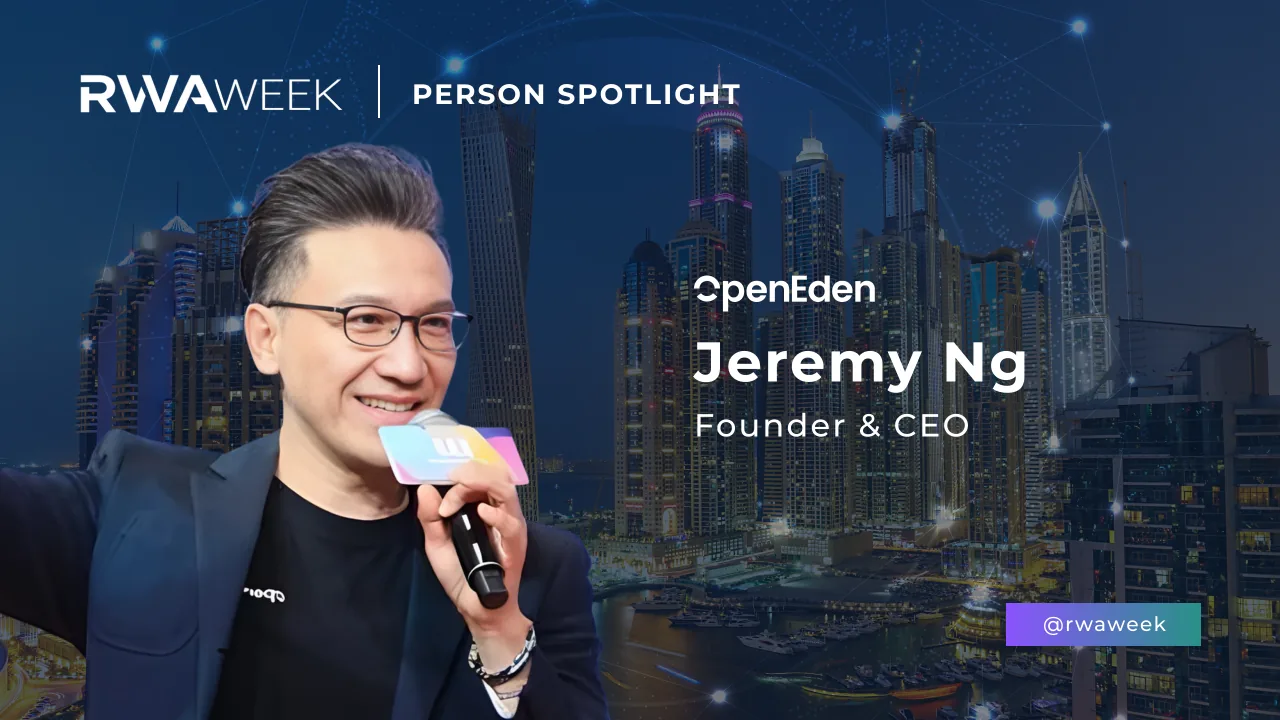
Person Spotlight: Jeremy Ng, Founder & CEO of OpenEden
Bringing traditional capital markets expertise to the onchain world — Jeremy Ng shares how OpenEden is building the trusted, compliance-first foundation for tokenized U.S. Treasuries.
RWA WEEK
Editorial
Person Spotlight: Jeremy Ng, Founder & CEO of OpenEden
Bringing traditional capital markets expertise to the onchain world requires more than technical knowledge — it demands a deep understanding of both world-class engineering and legacy regulatory compliance.
Jeremy Ng, CFA possesses exactly that rare balance. With a rich background spanning decades in traditional structured finance and investment banking across top global institutions, Jeremy transitioned into the digital asset space to lead Gemini's Asia-Pacific (APAC) division as Managing Director. There, he spearheaded institutional growth in a highly skeptical market, learning exactly what corporate treasuries and allocators require to cross the crypto bridge.
Recognizing that the onchain economy lacked a trusted, risk-free foundational asset class, Jeremy founded OpenEden. Built with a strict "compliance-first" ethos, OpenEden has achieved major milestones — including partnering with traditional giants like BNY and establishing a regulated, transparent structure that allows institutions to yield-bear via tokenized U.S. T-Bills. Today, Jeremy continues to guide the RWA movement away from mere narrative building and toward practical, secure financial engineering.
Background & Experience
1. You spent much of your career inside traditional capital markets before moving into digital assets through Gemini and later OpenEden. Looking back, what aspects of modern finance do you think blockchain improves dramatically, and which parts of the existing system are actually more efficient than crypto advocates like to admit?
The most dramatic improvement blockchain brings is settlement finality and transparency. In traditional markets, a simple equity trade takes T+2 days to settle, involves multiple intermediaries — custodians, clearinghouses, prime brokers — and generates enormous reconciliation overhead. Blockchain collapses that to near-instant, atomic settlement with a single source of truth. For cross-border payments and tokenized securities, this is genuinely transformative.
That said, I think crypto advocates consistently underestimate how efficient traditional market infrastructure already is at scale. The NYSE processes millions of trades per day with extraordinary reliability. SWIFT, for all its criticism, moves trillions of dollars globally with very low failure rates. The existing system's "inefficiencies" are often actually risk management layers — they exist because someone, somewhere, got burned without them. Replacing them requires not just better technology but equivalent or superior risk controls, which takes time to prove.
2. You helped build Gemini's presence in Asia during a period when institutions were still largely skeptical of digital assets. What did that experience teach you about the gap between how the crypto industry thinks institutions make decisions and how institutions actually make decisions?
The crypto industry tends to think institutions move slowly because of ignorance or bureaucracy. The reality is far more nuanced. Institutions move slowly because they are accountable — to regulators, to boards, to clients, to auditors. Every new asset class requires a complete review of custody arrangements, legal opinions, tax treatment, accounting standards, and risk frameworks. A family office might take six months to onboard; a pension fund might take three years.
What I learned at Gemini is that the single biggest unlock for institutional adoption is not yield or technology — it is trust infrastructure. Institutions need to know that if something goes wrong, there is a clear legal remedy, a regulated counterparty, and a paper trail. The crypto industry spent years building products before building that trust layer. OpenEden was founded specifically to build the trust layer first.
3. While many early crypto entrepreneurs focused on tokenizing equities, real estate, or exotic assets, OpenEden started with U.S. Treasuries. Was that primarily a risk-management decision, or did you see Treasuries as the foundational building block for an entirely new on-chain financial system?
Both, but the foundational vision came first. U.S. Treasuries are the risk-free rate — the bedrock of every financial model, every portfolio construction framework, every collateral regime in traditional finance. If you want to build a credible on-chain financial system, you need that bedrock to exist on-chain first. Everything else — lending, derivatives, structured products — can be built on top once the risk-free rate is reliably accessible on-chain.
The risk management dimension reinforced the decision. Treasuries are liquid, well-understood, and have decades of legal precedent around custody and ownership. Starting there meant we could focus on solving the tokenization infrastructure problem without simultaneously navigating complex underlying asset risk. It gave us a clean proving ground.
4. Today, tokenized Treasuries are often described as a bridge between TradFi and DeFi. In the long run, do you believe tokenization simply modernizes existing capital markets, or does it ultimately lead to a fundamentally different market structure altogether?
I believe it leads to a fundamentally different market structure, but on a longer timeline than most people expect. The near-term story is modernization — faster settlement, better collateral mobility, 24/7 markets. That is valuable but evolutionary.
The truly disruptive long-term outcome is programmable finance. When assets are natively on-chain, you can embed financial logic directly into the asset — automatic coupon payments, conditional transfers, real-time collateral rebalancing. You eliminate entire categories of intermediaries whose only function is to execute instructions that could be encoded in smart contracts. That is a structural change, not just an efficiency gain. But it requires regulatory frameworks, legal certainty, and institutional trust that will take a decade or more to fully develop.
5. The industry often frames tokenization as a technology challenge, yet the real bottleneck may be trust, regulation, and institutional credibility. After years working with banks, regulators, custodians, and crypto-native firms, what do you believe is the single hardest problem the RWA industry still has not solved?
Legal enforceability across jurisdictions. Technology is largely solved — we can tokenize almost anything. Regulation is progressing — MiCA in Europe, MAS frameworks in Singapore, emerging clarity in the US. But the moment a tokenized asset crosses a border, you enter a legal grey zone. Whose law governs? Which court has jurisdiction? How does a token holder enforce their rights against an issuer in a different country?
Traditional finance solved this through decades of treaty frameworks, correspondent banking relationships, and standardized documentation like ISDA master agreements. The RWA industry is still in early innings on building equivalent cross-border legal infrastructure. Until that is solved, truly global tokenized capital markets will remain constrained.
6. You have had a front-row seat to investment banking, crypto exchanges, and now the tokenization movement. Looking toward 2035, what is one widely held belief about tokenized assets or on-chain finance that you think the market will eventually discover is wrong?
The belief that decentralization is always preferable to centralization in financial infrastructure. The crypto community has a deep ideological commitment to decentralization, but financial markets have consistently shown that some degree of centralization — in clearing, in custody, in price discovery — actually reduces systemic risk and improves market function.
By 2035, I think we will see a hybrid model where the settlement and record-keeping layer is decentralized and transparent, but the risk management, compliance, and dispute resolution layers involve regulated, accountable intermediaries. The purist vision of fully trustless finance will remain a niche. The mainstream will be "trust-minimized" finance — where you verify rather than blindly trust, but where human accountability still exists at critical junctures.
Originally published on LinkedIn Pulse by RWA WEEK.