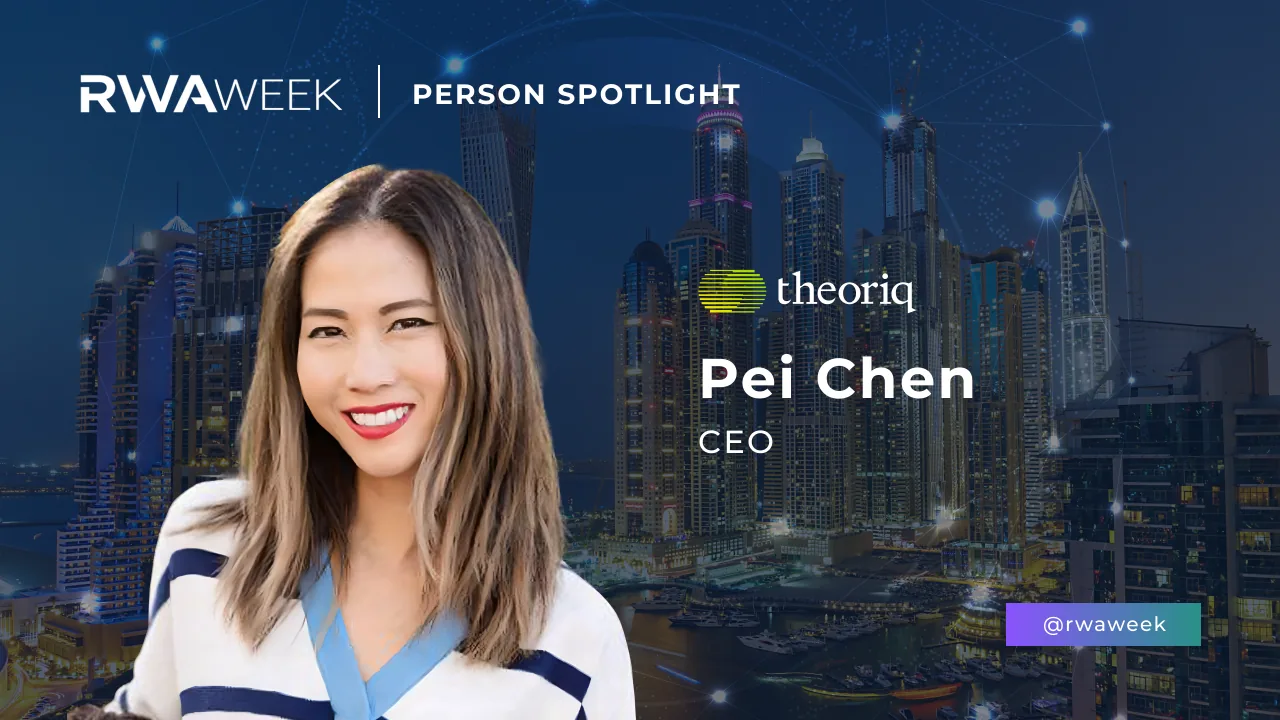
Person Spotlight: Pei Chen, CEO of Theoriq
As artificial intelligence and tokenized real-world assets converge, few executives are better positioned than Pei Chen, CEO of Theoriq, to bridge both worlds. In this spotlight, she shares her vision for AI-powered DeFi and the future of institutional RWA.
RWA WEEK
Editorial Team
As artificial intelligence and tokenized real-world assets converge, a new generation of financial infrastructure is emerging — one designed not only to move capital more efficiently, but to allocate it more intelligently. Few executives are positioned more uniquely at that intersection than Pei Chen, CEO of Theoriq.
Pei's career bridges two worlds that are increasingly becoming one. She began in traditional finance at Goldman Sachs, where she developed expertise in fixed income markets, risk management, and institutional capital allocation. She later moved into blockchain and digital asset infrastructure, holding leadership positions across ConsenSys, RootstockLabs, and the Sei Foundation, helping shape the foundations of institutional crypto adoption.
Today, as CEO of Theoriq, Pei is leading the company's evolution into a focused AI-powered asset management platform for tokenized real-world assets. Following a strategic reorganization in 2026, Theoriq narrowed its focus to AI-augmented curation of RWAs, combining quantitative research, machine learning, and onchain execution to create yield-generating products for institutional and crypto-native investors alike.
The company's thesis is straightforward but ambitious: tokenization solves ownership, while AI-driven curation solves productivity. Through products such as Theoriq Gold Vault and AlphaVault, the firm seeks to transform idle onchain assets into actively managed, risk-aware investment strategies, bringing traditional asset management discipline into programmable financial markets.
In this Person Spotlight, Pei Chen discusses her transition from traditional finance to AI-native asset management, the strategic pivot that reshaped Theoriq, the growing role of AI in tokenized capital markets, and why she believes the next generation of institutional asset management will be built at the intersection of intelligent software and onchain infrastructure.
Background & Bio
Q: Your career spans traditional finance at Goldman Sachs and foundational crypto infrastructure roles at ConsenSys, RootstockLabs, and the Sei Foundation. How did your experience managing risk and capital discipline in traditional fixed income shape your approach to building Theoriq's AI-curated vault products, particularly as you transitioned from the Executive Director role to CEO?
A: Looking back, it feels less like a series of career pivots and more like an inevitable journey following the same thread. At Goldman, I was managing high-stakes fixed income portfolios. This was the kind of work where precision in risk attribution and lifecycle management is not optional, it is the job. You develop a deep instinct for where exposure actually lives versus where it appears to live on paper, and that discipline never leaves you.
But what I kept running into was the friction of the infrastructure itself. Settlement cycles, opacity in counterparty risk, the sheer inefficiency of moving capital across borders and asset classes through systems that had not fundamentally changed in decades. Crypto and blockchain were not a departure from that world, they were a better answer to the same problems I had been living with. ConsenSys, Rootstock, and Sei each taught me about building the rails that I believed institutional finance was eventually going to need. I was just earlier to that conviction than most of my peers.
Theoriq is where those two threads finally come together. My view is that AI is what actually unlocks the full potential of crypto rails. This isn't about just making them faster or cheaper, but making them intelligent enough to manage complexity at institutional scale. The strategies that are now possible onchain, the ability to actively curate across lending markets, yield venues, and collateral types in real time, that only becomes viable when you apply AI on top of the infrastructure. Crypto built the rails. AI is what makes them worth running at scale.
And the fixed income discipline around careful risk parameterization, verifiable attribution, and defined liquidity paths is exactly the standard that AI-curated vault products have to be held to if they are going to earn institutional capital. The transition into the CEO role has given me the flexibility to actually execute on that vision without compromises. What matters is having a team that genuinely understands where finance and technology are headed and shares the conviction that this intersection of AI and digital asset management is not a niche experiment, it is where the next generation of asset management gets built.
That is what makes it exciting to come to work. We are not retrofitting old ideas onto new technology. We are building something that could only exist now, and the people around me feel that too.
Q: Theoriq recently underwent a significant reorganization, separating from ChainML to focus exclusively on AI-augmented curation of tokenized Real World Assets (RWAs), discontinuing general-purpose agent products like AlphaChat. What was the defining institutional signal or market catalyst that gave you the conviction to double down on precision RWA curation over broader AI agent coordination?
A: The signal was a change in the question allocators were asking. For years the conversation was about whether an asset could be tokenized. By 2026 that was settled. The serious question became how to make a tokenized asset productive without taking on risk that cannot be priced, monitored, or managed. That is a curation discipline that requires a team with specific domain expertise and passion to merge TradFi asset management and DeFi yield strategies using AI.
General-purpose agent products like AlphaSwarm were a step removed from where durable value sits. They were capability in search of a market. Precise curation of tokenized RWAs is the opposite: a real, rapidly growing market with sophisticated allocators and a massive opportunity that is easy to state and hard to capture. The recent re-org allows the team to commit to the RWA market opportunity without distraction or reservation, with aligned incentives and shared goals.
We are lucky to be an early mover on the opportunity where risk discipline, capital management, and AI agent infrastructure mesh together. Precision, focus and results earn institutional trust.
Vision & Thesis
Q: You've noted that the convergence of AI and tokenized RWAs — a market exceeding $29 billion onchain in early 2026 — is a structural momentum rather than a speculative one. How exactly does Theoriq utilize machine learning and statistical modeling to generate verifiable yield on tokenized assets like gold, and what gives AI an edge over traditional quantitative strategies in this specific market?
A: The convergence is structural, not narrative, because supply and demand matured at the same moment. Tokenized assets moved onto institutional balance sheets, and the onchain venues to make them productive grew deep enough to use. Theoriq operates at the curator layer between those two.
Our model is human-led and scaled by AI agents. We set the strategy, the policy constraints, and the risk gates. Our agentic workflows do what no analyst can do 24/7, 365 days. That's monitoring borrow and lend rates, liquidity depth, and term pricing across protocols around the clock, finding where the best risk-adjusted spread sits, and executing inside the limits we define. When conditions move, it rotates. When a risk threshold is approached, it acts before exposure becomes a problem.
The edge over traditional quant is not a cleverer model in isolation. AI scales out our quant team's capabilities and effectiveness. This allows continuous enforcement of discipline across fragmented, always-on onchain markets, with every position observable onchain and yield attributed across subvaults. We do not ask anyone to trust the strategy. They can verify it.
Q: A core part of Theoriq's next chapter involves tightening token economics around product performance, ensuring that $THQ holders have a genuine role in product direction and direct exposure to the value created by RWA curation. Could you elaborate on the mechanisms you are exploring to route real value from institutional vault activity back to the community, and how this aligns with your vision of an "Agentic Economy"?
A: A token should align the people who build the products and carry risk in them. $THQ is an alignment instrument, and the next chapter is about tightening that alignment around product performance rather than sentiment.
The mechanisms we are working through include routing a defined share of the value that vault activity generates back to the participants who commit capital and conviction. A portion of vault revenue flows directly into THQ buybacks, creating a programmatic link between the productive use of capital onchain and the value of the token that governs it. rsTHQ, our reward staked token derivative, demonstrates the shape of the link: incentive yield is paid in a vested reward token, so the depositors who gain the most are the ones with real exposure to outcomes.
Personal Perspective Into The Future
Q: Theoriq Gold Vault has emerged as a top-performing onchain gold vault, addressing the fact that the vast majority of the $6 billion in tokenized gold sits idle. As institutional capital and major asset issuers increasingly enter the space, what are the biggest structural bottlenecks preventing traditional allocators from utilizing onchain yield products, and how is Theoriq positioned to solve them?
A: Tokenization solved ownership. It did not solve productivity, and on gold that gap is roughly six billion dollars wide between XAUt and PAXG combined. Most tokenized gold sits idle, on an asset that has historically cost money to hold. The demand to make it work is real. The obstacles are operational and structural, not philosophical.
First, custody and operational risk: institutions will not move size onchain until custody, controls, and reporting meet the standard they already hold their other assets to. Second, verifiable risk attribution: an allocator cannot underwrite the yield that it cannot decompose, so it has to see exactly where return comes from and what risk produced it. Third, liquidity and exit: allocators need dependable, defined withdrawal paths, not yield that quietly locks them in.
Fourth, and specific to RWA tokens, liquidity bootstrapping: a newly issued tokenized asset may be legally sound and technically onchain, but if it has no presence on centralized exchanges, no pool on Curve or Uniswap, and is absent from blue-chip lending markets like Aave or Morpho, a curator cannot efficiently build strategies around it. There is no collateral utility, no clean hedge, and no exit path beyond the issuer's own redemption portal. The infrastructure has to be built in parallel with the strategy itself, which is why RWA curation mandates take longer to scale than equivalent work on native crypto assets.
Theoriq is built to answer all those obstacles. Risk constraints are enforced in policy, not described in a deck. Every position is observable onchain and yield is attributed across subvaults. Withdrawals run on a defined window. We're making gold productive in gold terms while preserving the controls a serious allocator actually requires before committing.
Q: Leading a company at the intersection of two of the fastest-moving sectors — AI and decentralized finance — requires immense focus and adaptability. Personally, how do you balance the urgency of scaling vault TVL and deepening institutional pipelines with the rigorous risk management required to maintain the performance standards your products have set?
A: I don't see scaling and risk discipline as being in tension, though I understand why the question assumes they might be. In practice, one bad loss sets you back further than a year of conservative growth. Institutions have long memories and short patience for preventable mistakes, so the rigor is not a tax on ambition. It is what earns the next allocation and the one after that.
What that means day to day is that we grow at the pace our risk framework can genuinely support. We do not hit a target by quietly loosening a constraint. The discipline has to live in the system itself with human-set policy, continuous agent enforcement, and positions that are fully observable because performance that depends on someone being heroic on a given day does not survive real market stress. I have seen what happens when it does not, and I would rather be slower and still standing.
The personal side of it is narrower than people expect. My job is mostly to protect the standard the products are held to and to stop the team from mistaking motion for progress. It is easy in a fast market to feel like you are building something because the calendar is full. Pipeline and TVL actually follow from being the most dependable option an allocator has, and dependability is genuinely the hardest thing to build in this space.
The other thing I feel strongly about is that deepening institutional pipelines is not just a sales motion. It comes from looking at where assets are sitting idle and asking whether there is a more productive path for them. If there is a feasible case — a tokenized fund that could be doing more, a treasury that is under-earning, or a new market opening up — then connecting those dots quickly matters. Windows close fast, the field is competitive, and the people who move thoughtfully but decisively are the ones who build durable positions.
The tokenization of real-world assets is rapidly moving from concept to market infrastructure, while AI is redefining how information, risk, and capital are managed. At the intersection of those two transformations, Theoriq is pursuing a vision that extends beyond simply bringing traditional assets onchain — it is focused on making those assets intelligent, productive, and continuously optimized.
For Pei Chen, the challenge is not merely technological. It is about building institutional trust in a new financial operating system where transparency is native, execution is programmable, and asset management becomes increasingly AI-assisted. Theoriq's emphasis on verifiable attribution, disciplined risk management, and AI-powered curation reflects that broader ambition.
As institutional participation in tokenized markets accelerates and demand grows for productive RWA strategies, the firms capable of combining traditional financial rigor with next-generation technology will likely define the industry's next chapter. Under Pei's leadership, Theoriq is positioning itself to be among them.
To learn more, visit Theoriq.