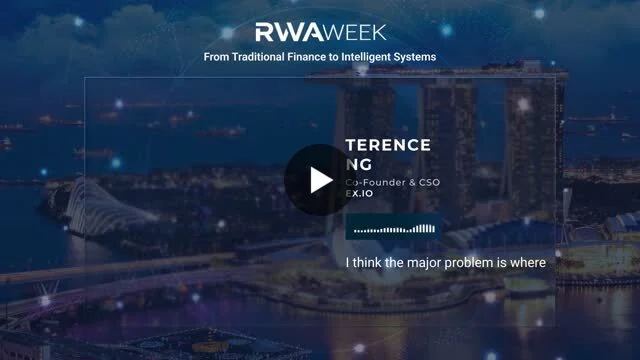
Person Spotlight: Terence Ng, Co-Founder & CSO at EX.IO
Terence Ng shares how EX.IO is building compliant, full-lifecycle RWA infrastructure in Hong Kong—and why intelligent, agent-assisted markets will define the next stage of on-chain finance.
Terence Ng
Co-Founder & CSO, EX.IO
From Traditional Markets to Tokenized Finance
What first convinced you that blockchain would become more than a speculative technology and evolve into a new financial architecture?
It came down to access. I spent years in traditional markets watching the same pattern repeat: a high-quality asset in one market, a qualified investor in another, and a wall of intermediaries, paperwork, and settlement delays between them. Blockchain did not simply digitize that process; it restructured the relationship between asset and owner. For the first time, you could have programmable ownership, instant settlement, and global distribution without rebuilding the entire plumbing each time.
The conviction solidified when I saw the demand side wake up—not retail speculators, but institutional allocators and family offices—asking the same question: how do I get exposure to this asset class without the friction I know from traditional markets? That is the gap EX.IO was built to fill. Not because we predicted the future, but because we listened to what capital was already looking for.
Building Through Hong Kong's Financial Evolution
How has your perspective on innovation changed as Hong Kong moves from financial hub to digital asset hub?
The shift has been from speed to credibility. In the early days of Web3, the playbook was move fast, apologise later, and let the market sort out the mess. Hong Kong took a different path: it built the guardrails first. That seemed slow to some, but it produced a regulatory framework that institutions can trust. And trust, in this business, is the only real moat.
Hong Kong's evolution is not about displacing its role as a global financial centre; it is about extending that centre's reach into digital assets. The city has the legal infrastructure, the capital depth, and the geographic position to be the bridge between East and West. That is not a replacement of its old identity—it is an upgrade.
From Tokenization to Intelligent Markets
Is the real opportunity not tokenization itself, but creating markets that can become increasingly autonomous and intelligent?
Tokenization is table stakes: it is the what. The real game is the how and the why. If all you are doing is mirroring a document on-chain, you have missed the point. At EX.IO, we are looking at RWA infrastructure combined with AI because the endgame is a market that can discover, price, match, and settle with minimal human latency.
At EXIO Group, EX.IO's parent company, we are building an AI-powered Growth OS, currently in internal MVP, to automate partner management, route deals across an extensive network of distribution partners, and handle revenue attribution. Think about an AI agent that can scan global macro data, identify a yield dislocation in tokenized credit, and surface it to a suitability-checked, risk-appropriate investor—with execution and settlement handled through compliant smart contracts under human oversight. That is the architecture we are building toward, and governance is built in from day one.
“Tokenization is the rails; intelligent markets are the trains. We are building both.”
Agentic AI as Financial Infrastructure
How do you see Agentic AI changing capital formation, investment banking, and asset management over the next decade?
Agentic AI will do for capital markets what algorithmic trading did for equities, but across every asset class. In capital formation, AI agents are likely to absorb much of what the roadshow does today. They will continuously scan investor mandates, match them with issuer profiles, and optimise pricing in real time. In investment banking, the analyst model changes: instead of 100 humans building pitchbooks, AI agents can run scenario analysis across thousands of variables, while humans make judgment calls on the outliers.
For asset management, the shift is from discretionary to augmented discretionary. The portfolio manager does not disappear; they become the conductor of an orchestra of agents, each handling execution, risk monitoring, compliance checking, and rebalancing. The firms that win will not be the ones with the most AI; they will be the ones with the best governance over AI.
At EXIO Group, we are embedding this thinking into RWA infrastructure not as a feature, but as infrastructure. AI agents need a legal-like layer: they can choose assets, but they cannot verify the legality of those assets. That is where full-stack RWA infrastructure becomes essential.
The Missing Layer for RWA Adoption
What is the most underestimated bottleneck preventing RWAs from reaching institutional-scale adoption?
Everyone talks about regulation, liquidity, and technology. Those are necessary, but they are not sufficient. The most underestimated bottleneck is sustainable operational continuity: the ability to demonstrate, day after day, that the token on-chain is irrevocably linked to the asset off-chain, and that cash flows, corporate actions, and governance rights are executed as promised. It is not the flashiest part of the business, but it is where trust is actually built.
This is why EXIO Group invested in full-lifecycle RWA infrastructure covering issuance, tokenization, custody, primary distribution, secondary trading, and fiat settlement. The end-to-end approach is about doing the unglamorous work of connecting every dot in the value chain—not just issuing tokens, but ensuring the entire machinery behind them runs reliably, transparently, and at scale.
Hong Kong's Long-Term Competitive Advantage
What unique advantage does Hong Kong possess that the market may still be underestimating?
The market tends to compare jurisdictions on surface metrics: licensing speed, tax treatment, and marketing budgets. But the real differentiator is structural optionality. Hong Kong is one of the few jurisdictions—and the only one of its scale—that combines proximity to mainland China's capital pools, a Common Law legal tradition global institutions already understand and trust, and a freely convertible currency pegged to the US dollar.
Hong Kong is not simply a gateway into China. It is the bridge through which Chinese enterprises and asset owners connect with global capital, and through which global investors access China-linked opportunities. As tokenization matures, that bridge function can deepen through established channels in a regulated, institutional-grade manner.
At EX.IO, we made a deliberate bet on this architecture: completing the full SFC licensing process, joining the government's strategic enterprise programme, and building our stack—from tokenization to custody to secondary trading—within those guardrails. When institutional capital is ready to move, the goal is not to scramble to become compliant, but to already be there.
Stay Connected
Terence Ng's perspective is a reminder that sustainable financial innovation relies on robust infrastructure, regulatory clarity, and operational continuity. As markets transition toward intelligent systems and programmable rails, full-stack platforms that maintain the bridge between off-chain realities and on-chain capabilities will continue to define institutional-grade finance.
Read the original interview on LinkedIn and learn more about EX.IO.
Disclaimer: The views expressed in this interview are those of the speaker and are provided for general informational purposes only. They do not constitute investment advice, an offer, or a solicitation to buy or sell any virtual assets, securities, or financial products.